
SPV confirms your equipment is ready before the work begins
For decades, the inspection industry has accepted a quiet trade-off: calibration proves an instrument met requirements at a point in time, and everything that happens between calibration cycles is a matter of trust. Crews mobilize, technicians run scans, and the industry lives with the gap.
Why?
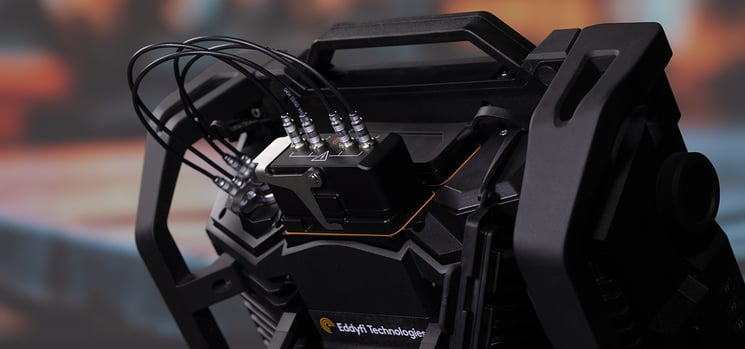
System Performance Verification (SPV), a new capability for Cypher available through Eddyfi's Customer Success Program (CSP), closes it. SPV adds something the industry has never had at scale: a fast, structured way to confirm equipment is ready to work, every day, at the point of use.
SPV answers the question calibration was never designed to answer
SPV is easy to dismiss as a convenience feature, a nice-to-have check for a nervous technician. That reading misses what it actually changes. Calibration and SPV answer two different questions, and the industry has only ever had tools for one of them.
Calibration assures compliance. SPV assures daily readiness.
The distinction matters because the two processes are designed for different decisions. Calibration is scheduled, controlled and traceable. It confirms that a system met requirements when it was tested. SPV is on demand, field-based and operational. It confirms that the system is behaving as expected before the work begins.
That is a new layer of quality assurance sitting between formal calibrations, one the industry has not had a standardized way to fill until now.
Put side by side, the distinction is simple:
| Calibration | SPV |
| Formal Compliance | Daily Readiness |
| Scheduled | On Demand |
| Lab Based | Field Based |
| Periodic Evidence | Point-of-Use Confirmation |
How it works
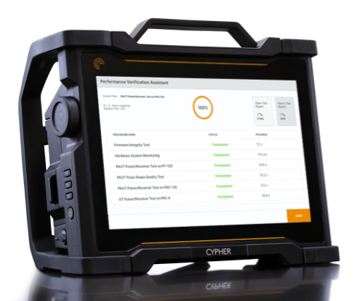
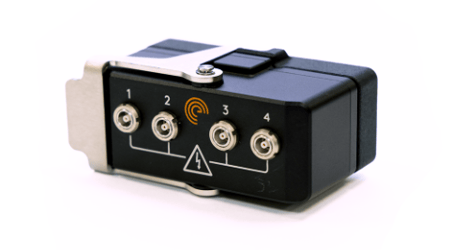 The mechanics are deliberately simple because the value is in speed and certainty. An operator connects the SPV plug into an IPEX connector, runs the automated procedure and follows a few guided steps. No deep metrology expertise required, and no ambiguity in the result. Within minutes, the system checks critical performance parameters against defined thresholds based on real standards and returns a clear pass or fail.
| System Performance Verification Parameters |
|||
| PAUT Pulser/Receiver Health | Conventional UT Pulser/Receiver Health | Firmware Auto-Tests | System Monitoring |
| Amplitude | Amplitude | Components Integrity | Computer Performance Power |
| Pulse Delay | Pulse Delay | Digitizer Integrity | Supply & Battery Health |
| Noise Level | Noise Level | High-Tension Boards Integrity | Temperature Consistency |
| Pulse Shape |
Every verification provides an intuitive report for quick validation of all SPV parameters. Reports can be saved as HTML or PDF files for traceability and auditing.
 The economics of confidence
The cost of uncertainty rarely appears as a single line item, but service companies feel it every day. A stalled morning is lost productivity. A unit shipped back just in case is freight, downtime and reduced fleet availability. A technician waiting on a replacement is capacity that cannot be billed. A mobilization that starts on instinct instead of evidence carries risk that only becomes visible when it affects schedule, margin or customer confidence.
SPV changes the economics of reassurance. A verification completed in minutes, at the point of use, gives crews a documented answer before they commit the day to the job. For organizations managing frequent mobilizations, that means fewer stalled starts, fewer unnecessary investigations, fewer avoidable returns and better utilization of equipment already in the field.
For quality and compliance stakeholders, SPV also provides an additional verification record between formal calibration events. It strengthens the quality routine by giving you visibility into equipment behaviour when performance matters most.
Traceability for every inspection
Running periodic SPV tests not only supports daily work assurance, it also confirms inspection confidence in previous work.
An instrument might pass a calibration inspection in January, but the following January, it fails. Somewhere in that twelve-month window, the system drifted out of tolerance, but the calibration record alone can't say when. Without that answer, every inspection performed with that instrument during the year is now in question.
Now picture the same scenario with weekly SPV checks. Instead of one data point at the start of the year and one at the end, there are fifty-two. If the unit starts failing SPV tests in October, that's the answer: inspections through September can be trusted, and only the work after October needs a second look. A twelve-month liability window shrinks to a three-month one, backed by a documented timeline instead of a guess.
That's a kind of traceability calibration alone can't offer.
Accredited calibration remains the gold standard
Accredited calibration remains the authority for formal compliance. SPV fills the space between those events, where, until now, teams had nothing but instinct to rely on.
SPV gives inspection teams a fast, objective, field-based way to verify system performance before confidence becomes downtime. It protects schedules, productivity, and confidence in inspection results. Most importantly, it moves teams from hoping the system is ready to knowing it is.
SPV is available now for Cypher through Eddyfi's Customer Success Program, with additional product coverage planned. Contact your Eddyfi representative to bring daily readiness into your inspection routine.