Definition: What is High Temperature Hydrogen Attack (HTHA)?
HTHA occurs when hydrogen at high temperature migrates into steel and reacts with carbon to form methane, which becomes trapped in the material as microscopic bubbles at grain boundaries. Over time, bubbles can grow and link, leading to fissuring and cracking.
Because early damage is made of very small voids and subtle microstructural changes, detection requires techniques that combine sensitivity to tiny reflectors with high resolution to separate real damage from benign reflectors.
Why HTHA Is Hard to Detect with UT (and What “Good” Data Looks Like)
Early HTHA can appear as very small voids and subtle decarburization, producing low-amplitude responses that can be masked by geometry echoes and microstructural noise.
A practical HTHA UT technique must (1) be sensitive to tiny volumetric reflectors, (2) maintain high spatial resolution to separate close indications, and (3) cover the potentially affected area efficiently, especially in welds and HAZ.
High temperature hydrogen attack happens in an environment where high temperatures and the presence of hydrogen are combined, mostly to low alloy steels. The high temperature causes some of the hydrogen to change into its atomic form which allows it to migrate into the steel. Inside the steel, the hydrogen will react with carbon and form methane which cannot migrate through the steel. Therefore, it gets trapped in the metal, typically as microscopic methane bubbles at the grain boundaries in the steel (stage 1). As these bubble start to grow, they start to coalesce (stage 2) and eventually lead to fissuring and cracking (stage 3). HTHA occurs preferentially in welds, heat effected zones, and in material that received no heat treatment.
As a result, HTHA may express itself in various shapes including decarburization and small voids in the early stages, linked voids at intermediate stages, and blisters and crack-like damage in the late stages. Due to the variation in defect shapes and the small size of early damage, HTHA is a challenging ultrasonic examination task. API RP 941 historically referenced manual UT techniques such as Advanced Ultrasonic Backscatter Technique (AUBT). The 2020 update includes more recent options such as TOFD, PAUT, and Total Focusing Method, reflecting field adoption for early HTHA detection challenges.
TULA probes (Ultra Low Angle TOFD) are also used as a practical variant for certain inspection geometries. We should also mention the TULA probes which are essentially Ultra Low Angle TOFD, or TULA, probes. All these news tools are available with Cypher® software's embedded flaw detectors by Eddyfi Technologies.
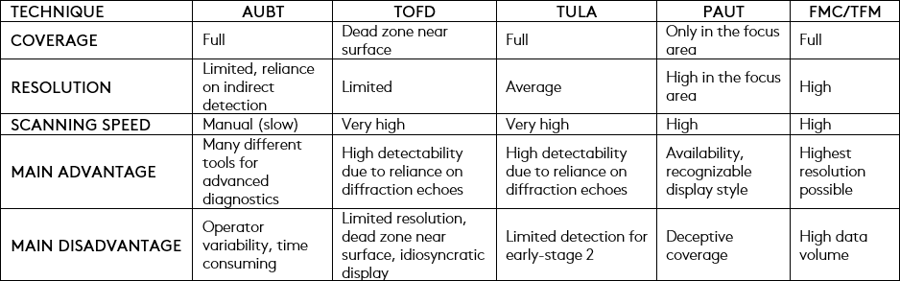
Given the properties of early HTHA damage being a small void in the material, it is important that the inspection technique is sensitive to small defects, while also able to cover the potentially affected area efficiently. For correct characterization, it is also helpful that the technique has a high resolution to distinguish the anomalies from other reflectors. The following table shows an overview of the five techniques with their main advantages and disadvantages.
Technique Overview (why operators combine methods)
- AUBT: legacy backscatter-focused approach used historically for early damage indications.
- TOFD / TULA: diffraction-based methods that can help detect crack-like damage and provide sizing cues when applicable.
- PAUT: flexible angle coverage, often used with optimized probes and procedures for weld/HAZ targeting.
- FMC/TFM: provides high-resolution imaging by focusing everywhere in the ROI, improving the ability to detect and separate small defects.
In practice, selection depends on defect stage (voids vs fissuring), access constraints, and the need for high resolution and repeatability.
TFM with New Probe for HTHA
For early HTHA, improving passive-plane resolution is critical because damage features can be only dozens of microns across, and poor passive focusing makes close indications merge and look elongated.
FMC/TFM was recently added to the ASME Boiler and Pressure Vessel Code and successfully used for the inspection of HTHA. A paper from BP co-authored with Eddyfi Technologies, Assessment of High-Temperature Hydrogen Attack Using Advanced Ultrasonic Array Techniques, was published November 2020 in Materials Evaluation, receiving the 2021 Outstanding Paper Recognition from the American Society for Nondestructive Testing (ASNT).
As FMC/TFM focuses everywhere within a region of interest, it offers optimum spatial resolution along the active plane which is vital for the detection of small defects such as HTHA. It is however still important to optimize the probe parameters (pitch, frequency, wedge, etc.) to minimize this spatial resolution while avoiding grating lobes. We have developed a new PAUT probe for the inspection of four 35-millimeter (mm) [1.4-inch(in)] samples, which improves sensitivity over standard PAUT probes.
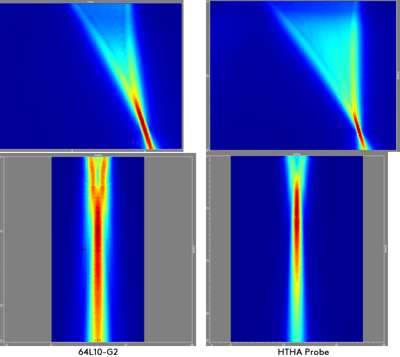
Evidence: Beam Spot Improvement (standard probe vs HTHA probe)
- Active plane: similar performance, with a small focal spot improvement reported from about 1.0 mm to 0.8 mm in the worst-case pixel.
- Passive plane: the HTHA probe beam is reported as one half to one third of the standard probe, resulting in a focal spot surface about 2.5× smaller at its best point.
Why it matters: smaller passive-plane spot improves sensitivity and helps distinguish coalescence patterns rather than smearing small reflectors into one elongated indication.
Evidence: Smallest FBH Detectability in this Mockup
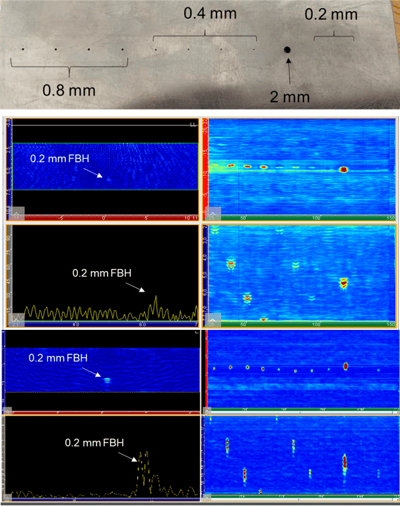
In a 10 mm-thick mockup with FBHs from 2.0 mm down to 0.2 mm at different depths, the standard probe struggles to detect the 0.2 mm FBH, while the HTHA probe detects it with a reported SNR of 14 dB.
With the larger passive-plane beam of the standard probe, indications appear more elongated, which reduces the ability to separate close reflectors. Due to the larger beam along the passive plane for the standard probe, defects appear elongated along the horizontal axe making it more difficult to distinguish between close indications.
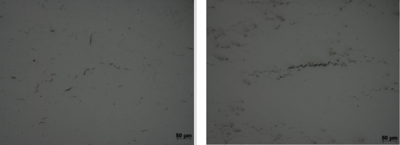
The HTHA sample that we looked at is a 150x45x25-millimeter (5.9x1.8x1-inch) block that contains manufactured HTHA. The test specimen was sectioned to expose HTHA cracks near the block surface. The specimen was metallographically ground and polished using procedures given in Practice ASTM E3-01 (2007) Standard Guide for Preparation of Metallographic Specimens. The following images show HTHA damage along one of the surfaces. One can see that defects are in the dozens-of-microns range while larger defects (~200-300 µm) appear (right image).
Test Conditions (so results are interpretable)
This specimen is a 150×45×25 mm block containing manufactured HTHA, sectioned to expose damage near the surface and prepared metallographically per ASTM E3-01 (2007) procedures.
Operational Settings Used in this Example
- Acquisition: FMC with the special probe and a one-axis encoder.
- TFM ROI: 30×20 mm with 90k pixels (pixel size 0.09 mm) selected to respect amplitude fidelity requirements.
- Scan speed: when data is collected every 1 mm, reported speed is 54 mm/s.
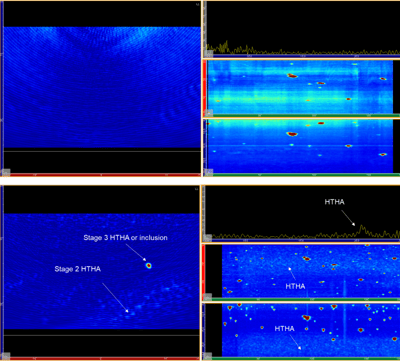
The following images show the results obtained with the standard probe (top) and the HTHA probe (bottom). The images display a T-scan (left) and A-scan, C-scan, and Sideview (right). The large features are visible with both probes; it is not clear at this point if they are inclusions or stage 3 HTHA for which microcracks have coalesced to form larger cracks as shown in the previous macrography image (right). It is not possible to clearly see the stage 2 HTHA with the standard probe, while it is clearly visible with the new HTHA probe.
We evaluated the same probe on the same sample using an SW55 wedge. Shear waves are typically used to look for HTHA in the Heat Affected Zone (HAZ) or the weld. Here, we used it to inspect the base material. The idea here is to minimize the dead zone and isochrones that are sometimes seen when using TFM with an L0 inspection. We use a 25x28-millimeter (0.98x1.10-inch) ROI with 219 kpixels. Despite the increase in pixel count, the scanning speed is 76 millimeters (3 inches) per second due to Plane Wave Imaging (PWI). This could be further improved by using the envelope of the TFM signal.
Key takeaway:
Using an SW55 wedge can help minimize dead zone and reduce isochrones seen in some L0 TFM inspections, and PWI can increase scan speed even when pixel count increases (reported 76 mm/s here).
As sensitivity is key here, we use the PWI acquisition scheme with TFM (learn more in this blog). PWI is essentially a sectorial scan using the full aperture of the array (64 elements here) combined with TFM reconstruction. The advantage is a gain in productivity as we use less angles compared to FMC, and more sensitivity as we fire all the elements rather than one at a time. One can obtain more sensitivity by using more angles but with reduced scanning speed. PWI is covered by the codes.
We calculated a Time-Corrected Gain (TCG) following the sensitivity correction described in ISO 23865 and as implemented in Capture software (learn more here). This is essential when performing HTHA inspection as operators want to have the same response wherever the HTHA is located in the ROI.
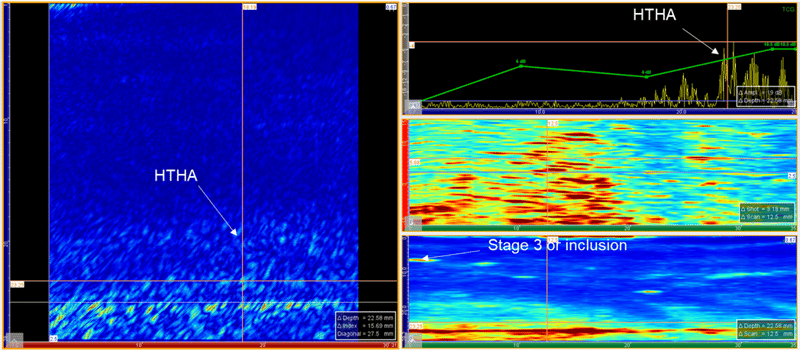
The following image shows the results obtained with the new HTHA probe. As before, we display a T-scan, A-scan, C-scan, and Sideview. One can see on the A-scan that the difference in amplitude between the base material (beginning of the A-scan up to 17 millimeters/0.7 inches) and the HTHA region is pretty big. We measure a 20 dB difference with the larger indications along the backwall. This difference is larger than the results obtained with a L0 wedge. This can be attributed to the smaller wavelength of the shear wave and the higher energy input of PWI.
The following video shows the results as we move along the scan axis. One can see pretty easily the area of the sample that contains HTHA.
When it comes to HTHA inspection, one must look for PAUT equipment that offers all the techniques recommended by API (UT, TOFD, PAUT, TFM), but also the the right probes and inspection configuration. Eddyfi Technologies has designed a new PAUT probe with better sensitivity and combined with PWI and TCG, we obtain higher sensitivity and better scanning speed than traditional and dual-linear array probes.
For surface inspection and detection of small cracks, our Eddy Current Array (ECA) solutions are well suited. Eddyfi Technologies ECA probes can be tailored to your application to provide quantitative and repeatable measurement, extracting length and depth information. Check out this application note on ECA in reformer tubes enabling the evolution from time-based to condition-based assessments. Moreover, the Alternating Current Field Measurement, or ACFM®, technique has a proven history of conducting high temperature inspections for surface-breaking cracks; learn more here. We invite you to contact us and discover the Beyond Current solution(s) for better HTHA inspection and so much more today!
Practical Checklist: Implementing TFM for HTHA Inspections
- Define the target stage (voids vs coalescence vs crack-like damage) and the target zone (weld/HAZ/base material).
- Use a high-resolution imaging method (FMC/TFM) when early-stage damage is expected, and prioritize passive-plane resolution to avoid elongated indications.
- Optimize probe parameters (pitch, frequency, wedge) to avoid grating lobes while maximizing resolution.
- Make your ROI and pixel size explicit and document how amplitude fidelity requirements are respected in the qualified procedure.
- Validate sensitivity on representative reflectors (for example FBHs down to your minimum target size) and record SNR thresholds used for calls.
- If dead zone and isochrones limit interpretation, consider wedge and path selection (for example SW55) and productivity options such as PWI.