.png)
What Is Corrosion Under Pipe Supports (CUPS)?
CUPS is corrosion that occurs at the contact zone between a metal component and the object supporting it, such as brackets, clamps, or resting supports. These locations trap water and create crevice conditions, leading to highly localized damage such as pitting and other forms of metal loss.
Why CUPS Is Difficult to Inspect
Direct hands-on access is restricted by the support, and lifting or adding secondary supports is typically avoided because corrosion severity is unknown and intervention can increase failure risk. This drives the need for inspection methods that can quantify remaining wall thickness without removing or moving supports.
Can the Cypher® and RMS PA with the PA-CAT™ technique be the answer to early detection of CUPS?
Why CUPS inspections fail in practice, what the typical workaround methods are (VT, RT, spot UT), and how PA-CAT changes the data quality and repeatability for corrosion profiling under supports.
Many pipe support designs like resting or mechanically fastened supports allow water to collect between the support and the pipe surface, thus creating an ideal environment for crevice corrosion. CUPS often occurs due to a lack of proper inspection and maintenance of the affected areas which are more likely in areas with low visibility or inaccessible directly below the supports.
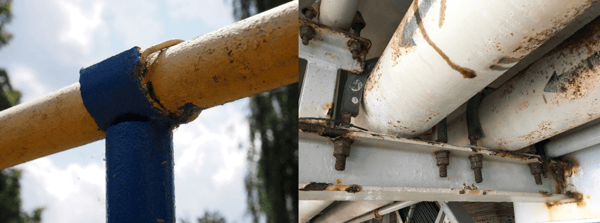
Figure 1: Simple Supports - Resting and Mechanically Fastened
Why traditional approaches struggle under supports
- Access constraint: the support blocks direct contact with the corrosion hot spot, and lifting the pipe is often avoided due to unknown severity and failure risk.
- Typical workflow today: visual screening to select targets, then RT or UT for follow-up.
- Why RT can be unreliable for quantification: corrosion measurement relies on image density and can vary with small changes in exposure angle and with interference from the support geometry.
- Why UT is preferred for quantification: UT is commonly regarded as the most accurate NDT method for locating corrosion and measuring remaining wall thickness and corrosion depth, feeding integrity decisions such as fitness-for-service and remaining life assessments.
Ultrasonic tools such as EMAT and guided wave have been used for CUPS screening, but their implementation and signal interpretation differ from conventional pulse-echo or pitch-catch UT that many technicians rely on.
When the goal is thickness quantification for integrity decisions, the method and reporting must be designed to produce repeatable measurements under the support constraint.
A new technique called PA-CATTM for inspection of CUPS was developed by Canadian company Holloway NDT & Engineering Inc. PA-CAT is a phased array corrosion assessment technique designed to estimate a corrosion profile under supports using standard PAUT instruments, probes, and scanners, rather than specialized hardware. PA-CAT uses equipment that many service companies already deploy (PAUT instruments, probes, and scanners), and the phased array approach produces a more robust and information-rich dataset than mono-element spot measurements in this application.
How the PA-CAT Workflow Produces Repeatable Outputs
- Input: phased array scan data plus inspection parameters such as pipe diameter and wall thickness.
- Processing: automated analysis based primarily on amplitude modeling of real corrosion to reduce inspector-to-inspector variability.
- Output 1: a corrosion profile (“river-bottom”) to support corrosion mapping interpretation.
- Output 2: couplant efficiency results delivered in a spreadsheet format that can be quickly adapted to reporting requirements.
Applicability (where PA-CAT fits today)
- Assets: applicable to pipes and vessels.
- Minimum diameter: 100 mm (4 in) and up.
- Minimum thickness: as low as 6 mm (0.23 in).
- Evidence to date: reported as reliable and repeatable in blind trials and laser prove-up in onshore and offshore applications.
Testing the Technology in the Field
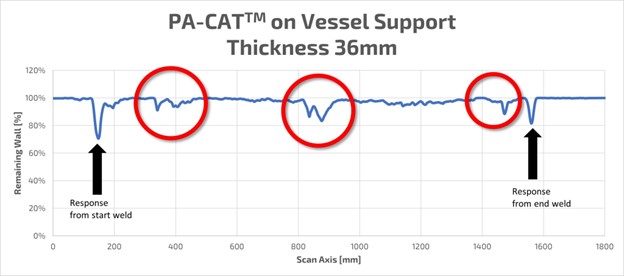
This field trial included associated pipework at 10 mm and 14 mm wall thickness, and a vessel at 36 mm wall thickness, specifically to evaluate CUPS capability prior to broader rollout.
TRAC Energy Ltd. was forming a long-term strategy of investing in new inspection advancements. Eddyfi Technologies along with Holloway NDT carried out various trial inspections on associated pipework at 10 and 14 millimeters (0.39 and 0.55 inches) wall thickness, and vessel at 36 millimeters (1.41 inches) wall thickness for the inspection of CUPS. This trial inspection provided TRAC Energy with a greater understanding of the capability of PA-CAT, prior to the roll out to TRAC Energy’s client base.
Key Takeaways
- CUPS inspections fail most often because the support blocks access and changes the measurement geometry, making repeatable quantification difficult with traditional approaches.
- PA-CAT is designed to use standard PAUT equipment to produce a more information-rich dataset and automated outputs that reduce inspector variability.
- Validate applicability first: confirm diameter ≥ 100 mm and thickness ≥ 6 mm, then qualify performance on representative supports before deployment.
If you want to confirm whether PA-CAT fits your support geometry and access constraints, contact our NDT experts to discuss your inspection requirements.
Practical Checklist: Qualifying a CUPS Inspection Approach
- Identify support types (resting, mechanically fastened, clamps) and confirm whether the hot spot is fully blocked or partially accessible.
- Do not plan to lift the pipe unless risk assessment allows it; assume restricted access as the baseline constraint.
- If using RT, document exposure angles and support interference risk, and treat thickness quantification as high uncertainty under supports.
- If using UT for quantification, define required outputs: remaining thickness, corrosion depth, and reporting format for integrity decisions.
- For PA-CAT, record pipe diameter and wall thickness inputs and verify couplant efficiency outputs remain within acceptable limits for repeatable analysis.
- Confirm applicability limits (≥ 100 mm diameter, ≥ 6 mm thickness) and qualify on representative supports before production rollout.